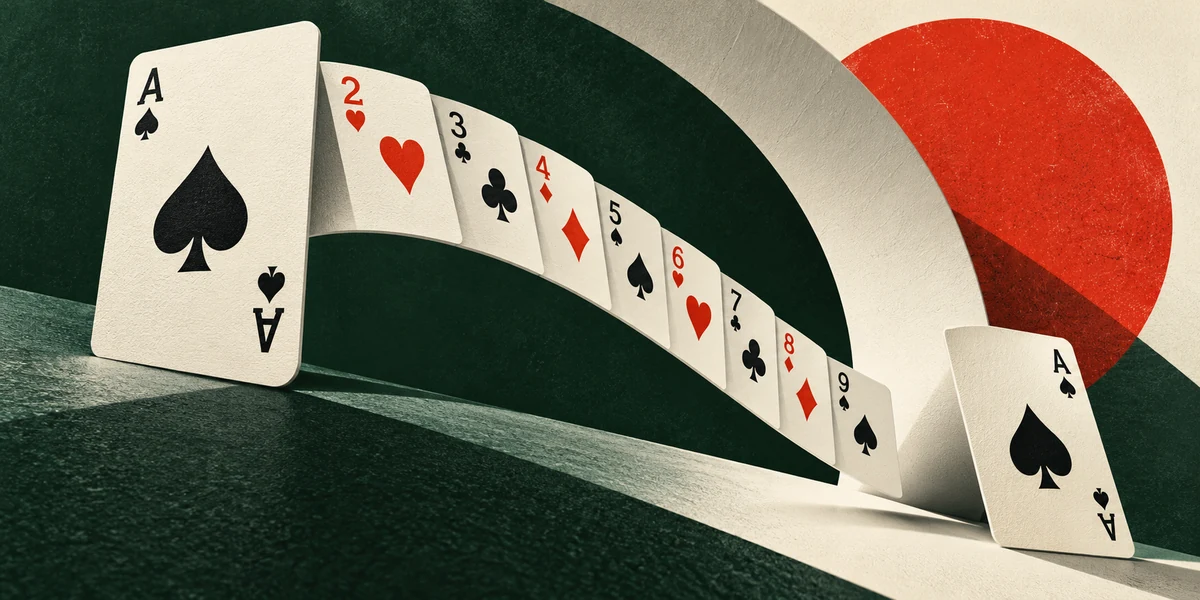
Why Soft Hands Are the Most Underplayed Weapon on the Felt
Key Takeaway: A soft hand cannot bust on a one-card draw, so it is the cheapest position in blackjack for adding risk. Double soft 13–18 aggressively against a weak dealer upcard (3 through 6). Never stand on soft 17. Treat soft 18 as a three-way decision (double, stand, or hit) that depends entirely on the upcard. Stand on soft 19 and 20, with one H17 exception: double A,8 against a 6.
I have watched players with decades of table time play hard 12 through 16 correctly and then hand their edge back on soft hands. They stand on A,6 because "17 is a good number." They stand on A,7 against a 9 because "18 is a winner." They hit A,4 against a 5 when they should have doubled. Each of these is a separate mistake, and they share one root cause: the player is reading the soft total as a fixed number instead of as a flexible hand with a safety valve.
A soft hand is any hand in which an Ace is counted as 11 without the total exceeding 21. That 11 can fall back to 1 when needed, which is why the hand is "soft." That fallback is the entire strategic story. In this guide I break down every soft archetype from A,2 to A,9, give you the expected-value comparisons behind each decision, and show you where the H17 rule changes the answer. If you have not yet memorized your hard totals, go through the learn basic strategy guide first. This material assumes you already have that foundation.
The Mathematical Core: Zero Bust Risk on One Card
Start with the structural fact that drives everything else. The highest two-card soft total you can hold before drawing is soft 20 (A,9). The largest card you can draw is a 10-value card. Soft 20 plus 10 is 30, which demotes the Ace to 1 and leaves a hard 20. No single card can bust a soft hand.
If S + c ≤ 21 → new total = S + c (still soft)
If S + c > 21 → new total = S + c − 10 (now hard)
Worst case: S = 20, c = 10 → 20 + 10 − 10 = 20 ≤ 21
∴ P(bust | soft hand, one card) = 0
Doubling decision rule (per initial unit wagered):
EV_double = 2 × E[ stand EV after exactly one card ]
Double iff EV_double > max(EV_hit, EV_stand)
Hard-total reference: P(bust | hard 16, one card) = 8/13 ≈ 0.615 (infinite deck)
Compare this with hard 16, where roughly 61.5% of draws bust you outright. A soft hand gives you a free look at one more card. The worst result is a weak hard total, which you can then keep hitting. You never forfeit the bet on that first draw. This asymmetry is what makes soft doubles so profitable. When the dealer shows a 4, 5, or 6, the dealer will bust about 40–42% of the time no matter what you hold. Your soft hand lets you double the money on the table without adding any immediate bust risk.
Soft 13 through soft 17 are not real totals in any competitive sense. The dealer must reach at least 17 whenever they do not bust, so standing on anything below 17 wins only when the dealer busts. Soft 17 itself only ties a dealer 17 and loses to everything above it. These hands are drawing hands with a guaranteed safe first card. Your only real decisions are how much money to put behind the draw (double or hit) and, from soft 18 upward, whether drawing is still worth it at all.
Soft 13 Through Soft 16 (A,2 to A,5): The Low Soft Doubles
The low soft hands share one profile. Standing is nearly worthless, because you can only win if the dealer busts. Hitting is the default against strong upcards. The doubling window opens against the dealer's bust cards.
The simplified rule that many training charts teach is: double A,2 through A,5 against a dealer 4, 5, or 6; otherwise hit. It is a good working approximation. The precise multi-deck boundaries are a little narrower at the bottom:
- A,2 and A,3 (soft 13, soft 14): Double vs 5 and 6. Against a 4 in a 6- or 8-deck shoe, hitting edges out doubling by a fraction of a percent. In single-deck and double-deck games, doubling vs 4 becomes correct.
- A,4 and A,5 (soft 15, soft 16): Double vs 4, 5, and 6 in every common rule set.
- All four hands vs 2, 3, 7, 8, 9, 10, A: Hit. Never stand. Against a 2 or 3 the dealer does not bust often enough to justify doubling a hand that is still well short of a pat total.
The gradient makes sense once you look at what one card does for you. A,5 improves to 17–21 on an Ace, 2, 3, 4, or 5, which is five of the thirteen ranks. A,2 reaches 17–21 only on a 4, 5, 6, 7, or 8, and lands on a weak hard total on any 10-value card. The higher the soft total, the more of the deck's "bad" cards still give you a hand worth doubling, so the doubling window widens.
| Hand | Dealer | Stand EV | Hit EV | Double EV | Correct Play |
|---|---|---|---|---|---|
| A,2 | 4 | −0.21 | +0.04 | +0.03 | Hit (multi-deck) |
| A,2 | 5 | −0.17 | +0.08 | +0.10 | Double |
| A,2 | 6 | −0.15 | +0.11 | +0.15 | Double |
| A,4 | 4 | −0.21 | +0.04 | +0.05 | Double |
| A,4 | 6 | −0.15 | +0.11 | +0.17 | Double |
| A,5 | 5 | −0.17 | +0.08 | +0.13 | Double |
| A,5 | 6 | −0.15 | +0.11 | +0.19 | Double |
| A,5 | 7 | −0.47 | +0.01 | −0.14 | Hit |
All EVs are per initial unit, approximate infinite-deck S17 values rounded to two decimals. Use them for direction and relative size, not as exact figures. Look at the stand column. Standing on soft 13–16 against a 4–6 sits around −0.15 to −0.21, because you are relying entirely on a dealer bust. Against a 7 it collapses to about −0.47. No standing play exists on these hands.
Soft 17 (A,6): The Universal Law
This is the hand I most want you to fix today. You never stand on soft 17. That holds for every upcard, every deck count, and both S17 and H17 games. The decision is only ever between hitting and doubling.
Why do so many players stand? Because 17 sounds like a finished hand, and the dealer stops on 17 (in S17 games). But the dealer stops on 17 because the house rules force them to, not because 17 is good. A pat 17 cannot beat a dealer who makes a hand. It only pushes a dealer 17 and loses to 18, 19, 20, and 21. Standing on 17 as a hard total is something you accept because hitting a hard 17 busts too often. Standing on soft 17 means accepting that weak outcome when you could draw with zero bust risk. That is giving away money for nothing. I cover the psychology behind this leak in the standing on soft 17 mistake breakdown.
| Dealer Upcard | Stand EV | Hit EV | Double EV | Correct Play (Multi-Deck S17) | Cost of Standing |
|---|---|---|---|---|---|
| 2 | −0.15 | 0.00 | −0.01 | Hit | ≈15% |
| 3 | −0.12 | +0.03 | +0.05 | Double | ≈17% |
| 4 | −0.08 | +0.06 | +0.11 | Double | ≈19% |
| 5 | −0.04 | +0.10 | +0.18 | Double | ≈22% |
| 6 | +0.01 | +0.13 | +0.24 | Double | ≈23% |
| 7 | −0.11 | +0.06 | −0.02 | Hit | ≈17% |
| 8 | −0.38 | −0.07 | −0.30 | Hit | ≈31% |
| 9 | −0.42 | −0.15 | −0.46 | Hit | ≈27% |
| 10 | −0.42 | −0.20 | −0.55 | Hit | ≈22% |
| A | −0.44 | −0.17 | −0.58 | Hit | ≈27% |
Look at the dealer 2, 3, and 7 rows, where standing on soft 17 looks most reasonable to the untrained eye. Stand EV sits in the −0.11 to −0.15 band, while hitting is roughly break-even or slightly positive. Against a 6, standing is the only spot where it even edges above zero, yet doubling earns about 23 cents more per unit. No row in this table favors standing. The cost column shows the gap between standing and the best play, as a percentage of your initial bet. It never drops below about 15%. For context, the entire house edge in a good six-deck game is around 0.5%. One soft-17 stand per shoe gives back far more than that.
Your doubling range for A,6 is dealer 3 through 6. In single-deck games, extend it to the 2 as well. You will find full derivations of these breakpoints, including composition effects, in the soft hands expected value distributions on BlackjackMath.org. Their dealer-outcome convolution method is the cleanest public treatment of why the 3 becomes a doubling card for soft 17 but not for soft 13.
Sharp Tip (Marcus Vance): If you hit soft 17 and catch a 10, you now hold hard 17. Stand. That is not a contradiction. You were never trying to keep 17. You were buying a free draw at 18–21. Hard 17 is the price of the occasional miss, and it still beats the soft 17 you started with, because you got the draw for free. Also: if a house rule restricts doubling (for example, "double on 10 or 11 only"), soft 17 against a 3–6 becomes a hit, never a stand.
Soft 18 (A,7): The Most Mismanaged Hand in the Casino
Soft 18 is where intermediate players get tested. It is the only soft hand where all three actions are correct somewhere on the chart. The three regions are:
- Double vs 3, 4, 5, 6. Eighteen is a mediocre made hand against a bust card, and doubling it is worth significantly more than standing. If doubling is not allowed, stand. This is the "Ds" cell on a full chart.
- Stand vs 2, 7, 8. Against a 7, your 18 beats the dealer's most likely result, a pat 17. Against an 8 it roughly matches the dealer's most likely total, 18. Against a 2 under S17, standing narrowly beats doubling.
- Hit vs 9, 10, Ace. This is the counterintuitive one. Against these strong upcards, 18 is a losing hand when you stand, and the free draw improves your EV even though it feels reckless.
| Dealer Upcard | Stand EV | Hit EV | Double EV | S17 Play | H17 Play |
|---|---|---|---|---|---|
| 2 | +0.12 | +0.08 | +0.11 | Stand | Double |
| 3 | +0.15 | +0.11 | +0.17 | Double | Double |
| 4 | +0.18 | +0.14 | +0.23 | Double | Double |
| 5 | +0.20 | +0.17 | +0.29 | Double | Double |
| 6 | +0.28 | +0.20 | +0.35 | Double | Double |
| 7 | +0.40 | +0.17 | +0.13 | Stand | Stand |
| 8 | +0.11 | +0.09 | −0.04 | Stand | Stand |
| 9 | −0.18 | −0.10 | −0.32 | Hit | Hit |
| 10 | −0.18 | −0.15 | −0.37 | Hit | Hit |
| A | −0.10 | −0.09 | −0.35 | Hit | Hit |
Here is how to read the hit-vs-9 row. With a 9 up, the dealer finishes on 19 or better far more often than on 17 or 18. Standing on 18 therefore leaves you a significant underdog, at about −0.18. When you hit, an Ace, 2, or 3 gives you soft 19, 20, or 21, all of which play strongly against a 9. A 4 through 10 gives you a hard 12 through hard 18, and you continue by hard-total strategy. The draw is free on the first card, and enough of the outcomes improve the hand that hitting gains about eight cents per unit over standing.
Against the Ace, the hit-stand decision is close, within about a cent. The single-deck S17 chart even flips it to stand. In six- and eight-deck games, hit.
The S17-vs-H17 difference on A,7 vs 2 matters in practice. When the dealer must hit soft 17, a dealer 2 makes slightly stronger final hands and busts a bit more often overall. That combination tips the balance toward doubling. Read the dealer soft 17 rule article for the full list of H17 adjustments and the roughly 0.2% house-edge penalty the rule carries.
Soft 19 and Soft 20 (A,8, A,9): Stand, With One Exception
At soft 19 and above you hold a genuine made hand. Soft 19 standing EVs run strongly positive against the 2–8, and positive or near-even against the 9. Soft 20 is the second-best non-blackjack hand in the game. A draw cannot bust you, but it is far more likely to weaken your total than improve it. Seven of the thirteen ranks (4 through 10) turn A,8 into a hard total of 12 through 18. Stand on A,9 against everything. Stand on A,8 against everything, except in the following case.
The H17 exception: double A,8 against a dealer 6. When the dealer must hit soft 17, the 6 upcard becomes even more bust-prone. Doubling soft 19 into it beats standing by roughly half a percent of the initial bet. That is small in absolute terms, but it is real money at serious stakes. In single-deck games, A,8 vs 6 is a double under S17 as well. Card counters also double A,8 against a 4 or 5 at positive true counts. That is index play, outside basic strategy, but worth knowing it exists.
| Soft Hand | 2 | 3 | 4 | 5 | 6 | 7 | 8 | 9 | 10 | A |
|---|---|---|---|---|---|---|---|---|---|---|
| A,2 (13) | H | H | H* | D | D | H | H | H | H | H |
| A,3 (14) | H | H | H* | D | D | H | H | H | H | H |
| A,4 (15) | H | H | D | D | D | H | H | H | H | H |
| A,5 (16) | H | H | D | D | D | H | H | H | H | H |
| A,6 (17) | H | D | D | D | D | H | H | H | H | H |
| A,7 (18) | S† | Ds | Ds | Ds | Ds | S | S | H | H | H |
| A,8 (19) | S | S | S | S | S‡ | S | S | S | S | S |
| A,9 (20) | S | S | S | S | S | S | S | S | S | S |
Legend: H = hit, S = stand, D = double (hit if doubling is not allowed), Ds = double (stand if doubling is not allowed). * = double in single- and double-deck games. † = double under H17. ‡ = double under H17 and in single deck. Chart assumes 6–8 decks, S17, double after split permitted. Build the exact variant for your game with the Strategy Chart Builder.
Drilling It Into Muscle Memory
Memorize the soft chart as three bands, not as forty separate cells:
- Low band (A,2–A,5): Hit, except double against the dealer's bust cards. The window widens as your soft total rises, from 5–6 for A,2 and A,3 to 4–6 for A,4 and A,5.
- Pivot band (A,6–A,7): Double against 3–6. Then separate the two hands. Soft 17 hits against everything else. Soft 18 stands against 2, 7, and 8, and hits against 9, 10, and Ace.
- Top band (A,8–A,9): Stand, with the single A,8-vs-6 double under H17.
One more structural note. Multi-card soft hands follow the same totals, but doubling is usually only available on your first two cards. If you hit A,2 and draw a 4 for a three-card soft 17 against a 5, you cannot double, so you hit. You still do not stand. The same goes for a three-card soft 18 against a 4: it becomes a stand, because "Ds" falls back to standing when the double is unavailable. For the bankroll side of these aggressive doubles, including how the extra variance interacts with your bet sizing, work through the doubling down guide.
Soft hands reward the player who treats the Ace as optionality rather than as a number. Every time you double A,6 into a 5, hit A,7 against a 10, or refuse to stand on soft 17, you take the side of the math that most players at your table are leaving open. The individual gains are a few cents per hand. Over thousands of hands, that is a meaningful part of your edge.